The D.B. Reinhart Institute for Ethics in Leadership sponsors a series of lectures by internationally, nationally, and locally known speakers on a variety of topics related to ethics and leadership.
The lectures are intended to be both informative and inspiring and to address ethical issues in a variety of settings, including business, health care, science, religion, politics, and technology.
Lecture series events are open to the public and all are welcome. No ticket is necessary.
Upcoming Events
"Neighbors Again—Healing, Belonging, And Resilience after the 1994 Genocide Against the Tutsi"
Carl Wilkens
Thursday, Oct. 22, 7 p.m.
Viterbo Fine Arts Center Main Theatre
In this moving and thought-provoking presentation, Carl Wilkens shares firsthand stories from Rwanda before, during, and after the 1994 Genocide Against the Tutsi. As the only American who chose to remain in Kigali throughout the genocide, Wilkens witnessed both the depths of human cruelty and extraordinary acts of courage, compassion, and solidarity. Drawing on his experiences working alongside Rwandan colleagues to protect vulnerable children and families, he explores what it means to rebuild trust after unimaginable violence. Through powerful storytelling and lessons from Rwanda’s remarkable recovery, audiences are challenged to examine belonging, empathy, and their own capacity to bridge divides in their communities.
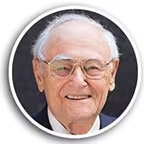
Holocaust Lecture with Holocaust Survivor Peter Feigl and Alexandra Zapruder
Thursday, May 6, 2027, 7 p.m.
Viterbo University Fine Arts Center Main Theatre
In summer 1942, the Vichy France government, in collaboration with the Nazis, began rounding up Jews and deporting them to German concentration camps in Poland. On Aug. 26, 1942, unbeknownst to Feigl, who was in a Quaker summer camp, his parents were arrested and deported to Auschwitz, where they were killed within a month of their arrival.
With the help of the Quakers, Feigl was sent to the predominantly Protestant village of Le Chambon-sur-Lignon. Sheltered in the surrounding area were nearly 5,000 people, among whom were 3,500 Jews, including many children. In the village, Feigl was given false identity papers and sent as a boarding student to a high school in Figeac, France. From there, after escaping arrest during a German raid in May 1944, Feigl escaped to neutral Switzerland over barbed wire fences with the help of the Jewish underground.
Zupruder began her career as a member of the founding staff of the United States Holocaust Memorial Museum in Washington, D.C. In 2002, Zapruder completed her first book, Salvaged Pages: Young Writers’ Diaries of the Holocaust, which won the National Jewish Book Award in the Holocaust category. Feigl's diary is one of the selections included in Salvaged Pages. Zapruder will be sharing insights into what we can learn from Holocaust first-person testimony.