

The Communication Disorders and Sciences
Profession
Speech-Language Pathologists (SLPs) are highly trained professionals who identify, assess, and treat a broad range of communication and swallowing disorders. Working across the entire lifespan—from neonatal care to end-of-life support—SLPs provide essential services that enhance quality of life and social participation.
SLPs practice in a variety of settings, including schools, hospitals, private clinics, and skilled nursing facilities. They operate as autonomous practitioners while frequently collaborating within interprofessional teams to provide holistic care. For more information and to explore the profession, visit www.asha.org.

The Scope
About the Profession
- Speech Production: Addressing articulation, phonology, and motor planning.
- Language: Supporting receptive and expressive communication, including literacy and social pragmatics.
- Cognition: Managing disorders related to memory, attention, and executive functioning.
- Feeding & Swallowing (Dysphagia): Ensuring safe and effective nutrition and hydration.
- Voice & Resonance: Treating disorders of the upper airway and vocal quality; therapy for phonatory and respiratory pathologies.
- Fluency: Managing disorders of speech flow, including stuttering and cluttering, by addressing rate, rhythm, and physical tension.
Explore programs
Find Your Program
View our undergraduate and graduate program options for students interested in communication disorders and sciences.
Rooted in Service: The Growing Impact of SLPs
Critical Need: Approximately 40 million Americans—roughly 12% of the population—live with a communication or swallowing disorder, creating a constant and growing demand for specialized clinical services.
Top-Tier Career: U.S. News & World Report ranks Speech-Language Pathology as #9 in the 100 Best Jobs of 2026 and #3 in Best Healthcare Jobs, reflecting exceptional job stability and professional satisfaction.
Exceptional Growth: The field is projected to grow over 15% through 2034—which is significantly faster than the average for all occupations—with approximately 13,300 new job openings expected annually.
Diverse Work Settings: While over 50% of SLPs are employed in educational settings, the remainder serve in high-impact medical environments including hospitals, private practices, and residential care facilities.
Why study this program at Viterbo?

Learning Through Direct Experience
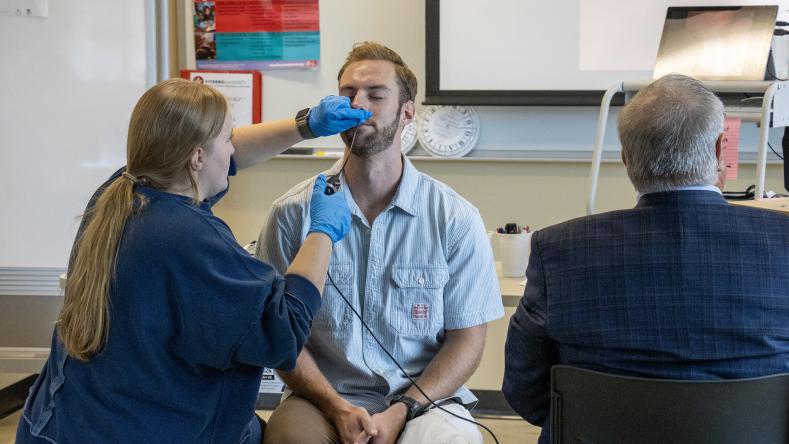
Develop critical thinking and problem-solving skills through participation in clinical externships, high-fidelity clinical simulation, class projects, community outreach, and research. Small cohorts and in-person classes facilitate shared experiences, in-the-moment feedback, and personalized instruction.

Emphasis On Inter-Professional Education
Learn to serve as a member of a multi-disciplinary team by engaging with students, faculty, and professionals in the fields of education, dietetics, nursing, occupational and physical therapy, social work, and medicine.

Service To the Community
Contribute to the health and communication needs of those in the Coulee region through student-led advocacy initiatives and provision of no-cost speech/language/voice/swallowing/hearing services at the public schools, on Viterbo’s campus, and at mobile outreach events.


Ready to Get Started?
Our online application is free and can be completed in just a few minutes. If you have questions regarding your program choice or the application, or if you would like to walk through the application with an admissions counselor, we're here to help!